
Creating a building is always a defining and deeply meaningful process. It is never merely about constructing walls and a roof — it is about shaping a home where generations may live, an office where ideas come to life, or a school where future generations are formed. Every building project carries both the aspirations of the Client and the professional expertise of the people involved in bringing it to reality.
When the right participants — architects, specialist engineers, and contractors — work together in harmony, the result is not simply a building, but lasting value: safety, comfort, architectural quality, and sustainable long-term operation.
It is important to understand that approximately 95% of a building’s overall energy performance, aesthetic quality, durability, and long-term value is determined at the design stage.
Good design is the foundation of every successful construction project. Even the most skilled contractor cannot fully compensate for incomplete or poorly considered plans. Architectural design is the phase in which the building’s functionality, spatial organization, environmental response, material selection, and technical performance are fundamentally defined. At this stage, there is still flexibility for optimization, refinement, and the integration of new ideas — whereas modifications during construction often result in substantial additional costs or may become impossible altogether.
At V2 Építésziroda, we believe that the careful development of a shared concept is the key to enabling contractors to work from precise and reliable documentation. With our detailed and thoroughly considered plans, construction becomes a controlled and predictable process rather than guesswork. The answers to the “how” questions are resolved in advance, ensuring a safer and more efficient realization process.
This approach allows the buildings created with our involvement to become not only visually refined and highly functional, but also durable, energy-efficient, and valuable in the long term.
Through our architectural and general planning services, we strive to ensure that every project achieves the highest possible technical, aesthetic, and functional quality — from the very first line to the final screw.
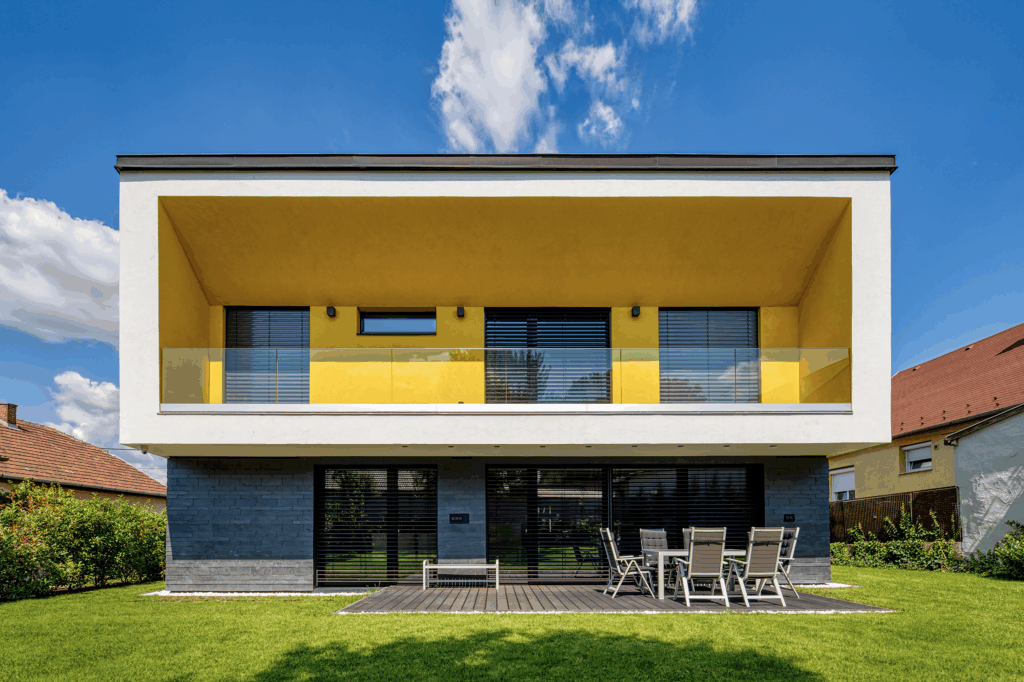
Architectural Design: Architectural design focuses on defining the building’s functionality, spatial organization, architectural character, material use, and overall aesthetic appearance.
General Planning: General planning involves the coordination and management of the entire design process, including structural engineering, building services engineering, and electrical engineering disciplines, ensuring that every aspect of the project works together coherently.
The general planning architect acts as the “chief conductor” of the project: coordinating all specialist designers so that every discipline moves in the same direction, resulting in a complete, consistent, and buildable documentation package — a true “roadmap” leading all the way to successful realization.
It is easy to see why integrated planning under one coordinated team creates a far more efficient workflow. Just as collaboration within a well-established company functions more smoothly when team members already understand each other, experienced design partners are better able to anticipate each other’s technical requirements and limitations based on previous collaborations.
The result is a shorter design process, fewer misunderstandings, and a reduced risk of errors — issues that occur far more frequently when previously unacquainted consultants attempt to work together for the first time.
Solid Foundations for Successful Construction – Well-designed plans combined with skilled execution result in a successful building. In contrast, incomplete or insufficiently developed plans cannot be compensated for — even by an experienced contractor.
Trusted Engineering Partners – Structural, mechanical, and electrical engineering disciplines coordinated under one management system, ensuring smooth collaboration and consistently high quality.
Time and Cost Reliability – Thoughtful design decisions made early in the process help prevent costly and difficult modifications during construction.
Detailed, Construction-Ready Documentation – Contractors receive clear and precise instructions, leaving no room for uncertainty or misinterpretation.
Energy-Conscious, Long-Term Solutions – Sustainability, low operational costs, and optimized energy performance are integrated into the design process from the outset.
Design of certified and certification-ready buildings using PHPP calculations, highly detailed documentation, and thermal bridge-free detailing.
Energy performance analysis, thermal bridge and PHPP calculations, as well as recommendations for optimized building assemblies and mechanical systems.
Optimization of construction details to minimize heat loss and condensation risk.
Site and property assessments prior to purchase, design reviews, and professional support in repositioning problematic or stalled projects.
Architectural design focuses on the architectural aspects of the building itself, while general planning additionally includes the coordination and integration of all engineering disciplines — including structural engineering, mechanical systems, and electrical design.
Fewer conflicts between disciplines, faster coordination, and a more predictable construction process — both in terms of execution and overall costs.
Our office strongly believes in comprehensive, fully developed design documentation. In our experience, the absence of detailed construction documentation often leads to compromised solutions that negatively affect the building’s appearance, technical quality, mechanical performance, and overall energy efficiency. In many cases, this ultimately undermines the very concept and architectural vision that initially convinced the Client during the design process.
Without construction-level documentation, the Client effectively relies on the contractor to invent and resolve critical technical details on site. However, this is neither the contractor’s responsibility nor an area where they can reasonably replace the role of the design team.
The cost of detailed construction documentation typically represents only approximately 2–4% of the total investment value, while the additional expenses and compromises resulting from missing or insufficient plans can easily exceed that amount many times over.
Ideally, the architect should be involved even before the site selection phase, as this is when the greatest flexibility — and the greatest potential savings — are still available. Once an unsuitable plot has been purchased, achieving the desired building size, orientation, layout, or energy performance often becomes possible only through significant compromises.

This website was created with the support of the Demján Sándor Program.
© 2026 V2 Építésziroda. All rights reserved. All textual and visual content on this website is the intellectual property of the author and may only be copied or used with prior written permission.